SparkyToolkit
Professional Electrical Tools for Sparkies · iOS · Adelaide, AU
// the problem
Most electrical calculator apps on the market are built by software developers with no trade experience. They get formulas wrong, use non-Australian standards, or bury basic tools behind clunky interfaces. On a real job site, electricians need answers fast, often in bright sunlight, wearing gloves, under time pressure. There's no single app that combines AS/NZS-compliant calculations, standards reference, test records, and site documentation in a way that actually works for Australian sparkies.
// the solution
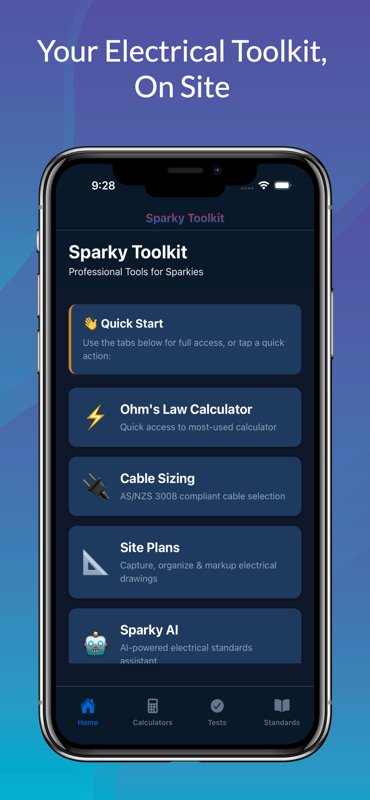
I built SparkyToolkit as a solo project over 18 months, drawing directly on my day-to-day experience as a working electrician. Every calculator, every workflow, and every interface decision is shaped by what I actually need on site. The app is live on the Apple App Store, free to download, and collects zero user data. It's designed to be the one tool an Australian electrician reaches for every day.
// 13 calculators
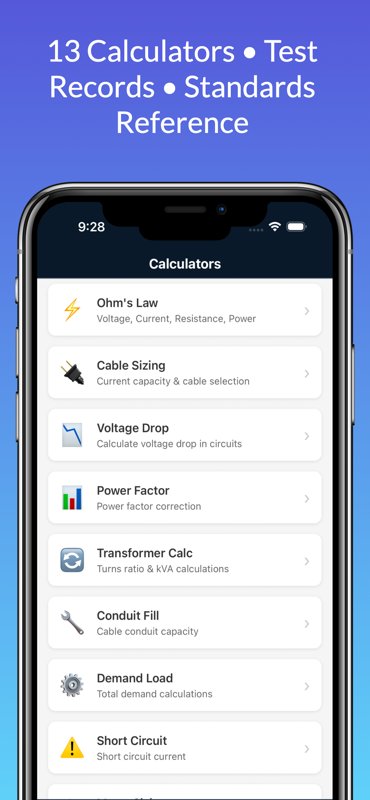
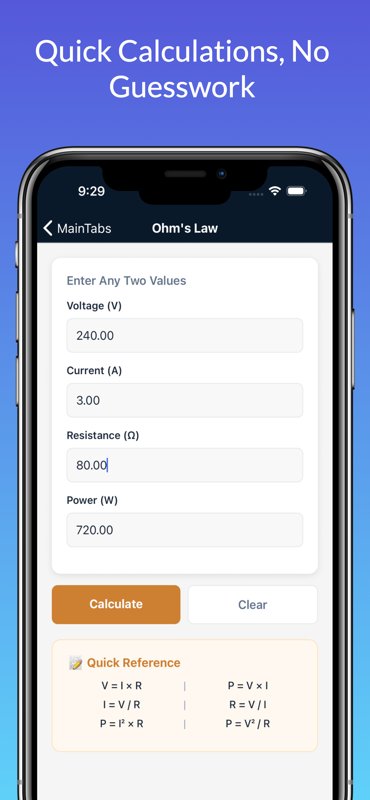
Every calculator is implemented to match Australian Standards formulas exactly, including multi-phase demand load calculations, conduit fill tables, and conductor sizing per AS/NZS 3008.
// key features
// architecture
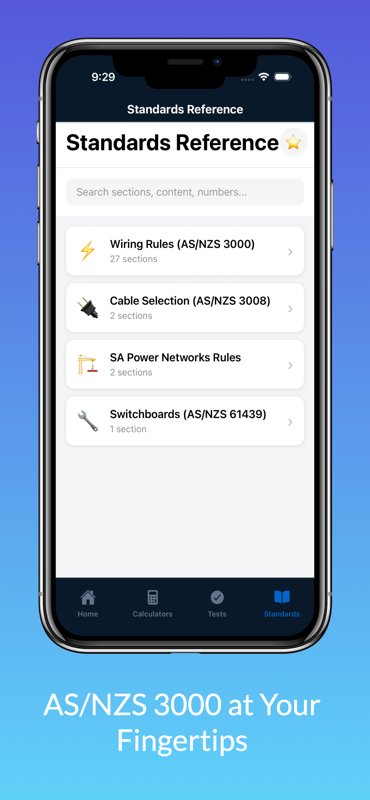
The frontend is built with React Native and TypeScript, deployed as a single codebase to both iOS and Android. The iOS build runs through Xcode on a Mac Mini M2, and the Android build through Android Studio. The backend runs on Oracle Cloud, providing a JWT-authenticated REST API and a RAG pipeline that ingests Australian electrical standards PDFs to power the AI assistant.
The AI backend uses a keyword-based RAG search over structured PDFs, which proved more cost-effective and accurate than vector embeddings for dense technical documents. The entire cloud infrastructure was migrated from a self-hosted home server (Dell T340 running Proxmox with Ubuntu and Tailscale VPN) to Oracle Cloud for reliability and scalability, with zero data loss during the migration.
// key technical challenges
RAG over structured PDFs was the biggest challenge. I engineered a pipeline capable of ingesting dense Australian standards documents and returning accurate, cited answers, overcoming the limitation that LLMs alone cannot reliably interpret niche compliance content. The keyword-based approach outperformed vector embeddings for this specific domain because electrical standards have very precise, structured language where exact clause matching matters more than semantic similarity.
Cross-platform code reuse was another key challenge. I structured the React Native codebase so the same src/ folder runs on both iOS and Android with only native build configuration differing. I also ran a self-initiated security audit that identified and resolved critical vulnerabilities including hardcoded credentials and division-by-zero edge cases in the calculators.
// app store screenshots
// what's next
SparkyToolkit is the foundation of a broader electrical industry software ecosystem. The immediate roadmap includes completing the security audit fixes and re-enabling the AI assistant, followed by a v2.0 release with an MCP + RAG hybrid architecture for direct access to cable sizing tables, current-carrying capacity tables, and voltage drop data from AS/NZS 3008. Further planned integrations include digitising the Ezystrut cable management catalogue for on-site part number lookup, and expanding market reach to tier 1 electrical companies across South Australia.
// tech stack